U.S. proposes Section 301 tariffs of up to 15% on Taiwan
The U.S. Trade Representative found on Nov. 25 that 14 economies, including Taiwan, have actionable excess-capacity practices and proposed tariffs. Taiwan's rate would be up to 15%, net of MFN duties. It is a proposal, not yet in effect.
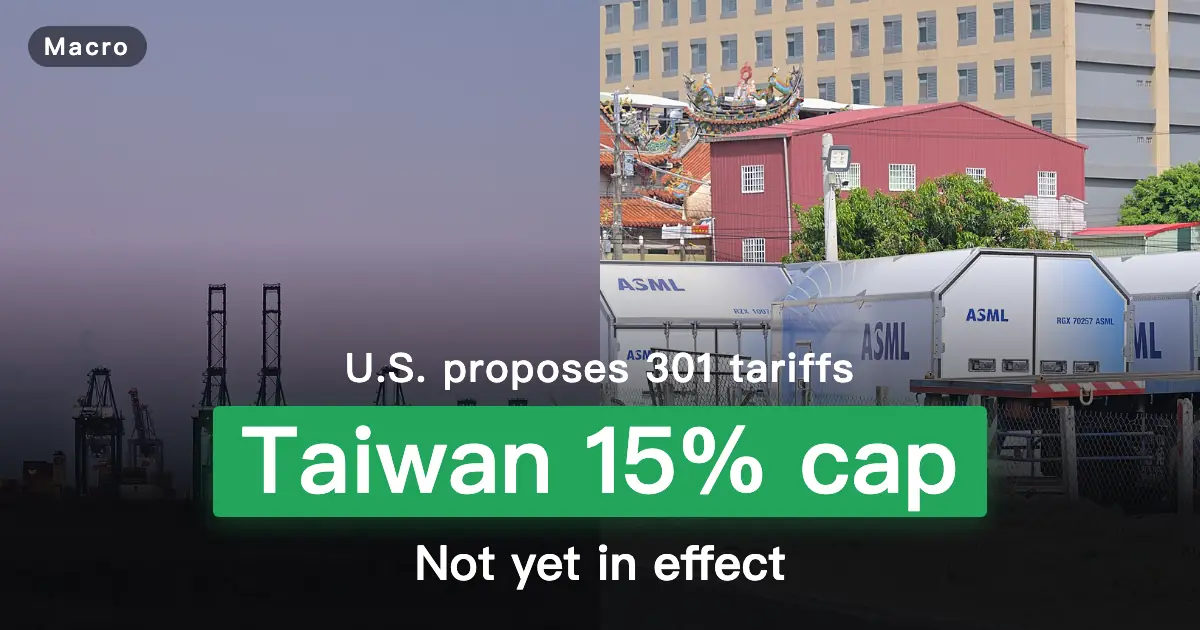
Part of our Nov. 26, 2026, brief. Written Nov. 27 from original sources.
Washington proposed new Section 301 tariffs on 14 economies, with Taiwan at up to 15%; nothing takes effect yet.
Key points
- USTR proposed tariffs on all goods of Taiwan of up to 15%, net of MFN rates and existing Section 301 tariffs, with exemptions for certain products, the agency said.
- An alternative of up to 25% would apply if Washington judges consultations and Taiwan's commitments unsatisfactory, Taiwan News reported, citing CNA.
- Written comments are due Jan. 5, 2027, and hearings begin Jan. 25, 2027; USTR gave no effective date, and Taiwan's Cabinet said the rate is not final.
Fourteen economies found actionable, two spared for now
U.S. Trade Representative Jamieson Greer determined on Nov. 25 that the acts, policies and practices of 14 economies relating to structural excess capacity in manufacturing are "unreasonable and burden or restrict U.S. commerce," USTR said. The investigations began on March 11 and covered 16 economies. USTR made no determination on Mexico or Norway "at this time."
| Economy | Proposed tariff (up to) |
|---|---|
| Taiwan, Japan, South Korea, EU, Switzerland | 15% |
| Bangladesh, Cambodia, Indonesia, Malaysia, Thailand | 18% |
| China, Singapore | 20% |
| India | 25% |
| Vietnam | 35% |
USTR said the rates for the EU, Japan, South Korea, Switzerland and Taiwan are net of MFN rates and existing Section 301 tariffs; most others are net of existing Section 301 tariffs only.
What USTR said about Taiwan
USTR listed nine Taiwanese practices, including recurring industrial plans to support high-technology manufacturing, state-directed research and development, financing mechanisms, financial repression, past purchases of U.S.-sanctioned Russian feedstock and inadequate protection of labor rights. The effects are "especially true" in electronics, semiconductors and telecommunications, it said.
USTR said Taiwan's proposal accounts for ongoing consultations and commitments in the U.S.-Taiwan Agreement on Reciprocal Trade (ART).
Taipei says the cap should hold
Vice Premier Cheng Li-chun said on Nov. 26 that the government expects the outcome to keep the negotiated 15% rate without stacking on MFN duties, Taiwan News reported, citing CNA. The Cabinet said the proposed rate is not final and a decision will follow statutory procedures.
Executive Yuan spokesperson Michelle Lee said a day earlier that the recommended rates would not be final decisions, according to the Taipei Times.
Market reaction
USTR released the proposal before Taiwan's market opened on Nov. 26. The Taiex rose 956.38 points, or 2.50%, to 39,151.81 that day, after falling 1,926.92 points on Nov. 25, according to the Taiwan Stock Exchange. Foreign investors net sold NT$49.18 billion while investment trusts net bought NT$21.21 billion, exchange data show. Media credited both the tariff proposal and a rebound from the prior day's drop; Baomazai does not split the two.
Why it matters
Taiwan's exporters sit in the lowest proposed tier. If final rates stay as proposed, Taiwan's rate would be 3 to 20 percentage points below rivals in Southeast Asia (Baomazai calculation: 18 − 15 to 35 − 15). USTR singled out electronics and semiconductors, but which Taiwanese goods are exempt depends on the Federal Register annex, which Baomazai has not reviewed item by item. Import prices are not affected until a final rate and effective date are set.
What to watch
- Jan. 5, 2027: Deadline for written comments and requests to appear at hearings (USTR).
- Jan. 25, 2027: USTR hearings on the proposed actions begin.
Sources
- OfficialUSTR: USTR Makes Determinations and Proposes Actions in 14 Section 301 Investigations Relating to Structural Excess Capacity (Nov. 25, 2026)
- OfficialTaiwan Stock Exchange: Daily Market Info (Nov. 2026)
- MediaTaiwan News (CNA): US proposes 15% all-in tariff for Taiwan under Section 301 investigation (Nov. 26, 2026)
- MediaTaipei Times: US Section 301 tariffs expected to remain capped at 15% (Nov. 25, 2026)
FAQ
What did USTR announce on Nov. 25?
USTR determined that practices of 14 economies relating to structural excess capacity in manufacturing are actionable under Section 301 and proposed tariffs for each, open for public comment. It made no determination on Mexico or Norway.
What rate is proposed for Taiwan?
Up to 15% on all goods of Taiwan, net of MFN rates and existing Section 301 tariffs, with exemptions for certain products, according to USTR. An alternative of up to 25% applies if consultations are judged unsatisfactory, Taiwan News reported, citing CNA.
When would the tariffs take effect?
USTR did not give an effective date. Written comments and requests to appear are due Jan. 5, 2027, and hearings begin Jan. 25, 2027. Taiwan's Cabinet said the proposed rate is not final.
For information only; not investment advice.
Spotted an error? Email editor@baomazai.com to tell us (the email will include this story’s link). We fix confirmed errors within 24 hours and log them on the corrections page.
Also in our Chinese edition: 美提301新關稅 台灣擬15%不疊MFN